Exchange-traded funds (ETFs) and mutual funds are two of the most common ways investors gain access to a diversified basket of stocks, bonds, or other assets without having to buy each security individually. Fund managers pool money from many investors and manage both according to a stated investment objective. Despite this similarity, these structures differ in meaningful ways — including how investors buy and sell them, how they price them, what they cost, and how they tax them. Understanding these differences matters because the structure of an investment vehicle can affect returns, flexibility, and tax outcomes over time, independent of how the underlying assets perform. This article explains the mechanics of each, compares their features side by side, and outlines who might consider one over the other.
What Is an ETF vs a Mutual Fund?
An ETF is a fund that holds a collection of securities and trades on a stock exchange, similar to an individual stock. Investors buy and sell ETF shares through a brokerage account at whatever price the market sets at that moment.
A mutual fund is also a pooled investment vehicle, but it does not trade on an exchange.The Exchange Commission’s Funds guide provides additional background on how mutual funds are structured and regulated. Instead, investors buy or sell shares directly through the fund company (or a broker acting on their behalf), and every transaction is settled at a single daily price.
Both structures can track an index, follow an active management strategy, or focus on a particular asset class, sector, or region.

How It Works
1. Fund creation. A fund manager assembles a portfolio of securities designed to meet a stated objective, such as tracking the S&P 500 or generating income from bonds.
2. Investor purchase. For an ETF, an investor places an order through a brokerage account during market hours, and the trade executes at the prevailing market price. For a mutual fund, an investor submits a purchase or redemption request that is processed after markets close.
3. Pricing. ETF prices fluctuate throughout the trading day based on supply, demand, and the value of the underlying holdings. The fund calculates mutual fund shares’ price once daily at the Net Asset Value (NAV) by dividing the total value of the fund’s assets by the number of outstanding shares.
4. Settlement. ETF trades settle similarly to stock trades. Mutual fund transactions settle based on that day’s closing NAV, regardless of when during the day the order was placed.
5. Ongoing management. The fund manager continues to buy and sell securities within the portfolio according to the fund’s strategy, whether that involves passively tracking an index or actively selecting holdings.
Key Features or Core Components
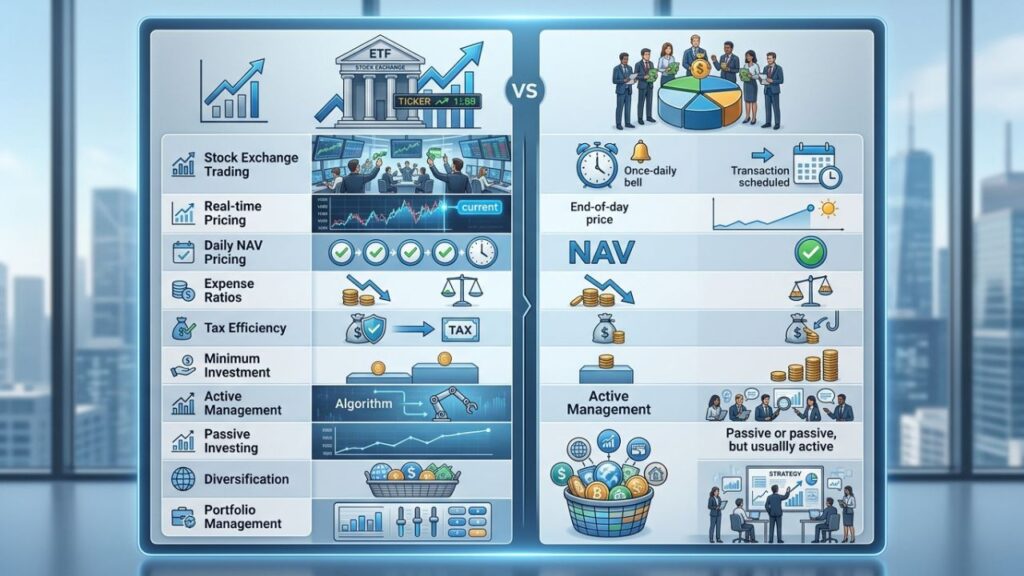
- Trading mechanism: ETFs trade continuously on an exchange; mutual funds transact once per day at NAV.
- Pricing transparency: ETF prices are visible in real time; mutual fund prices are only known after the trading day ends.
- Minimum investment: ETFs can often be purchased for the cost of one share or a fractional share; mutual funds may require a minimum initial investment, sometimes $1,000, $3,000, or more.
- Expense ratios: ETFs, particularly index-based ones, tend to have lower annual expense ratios than actively managed mutual funds.
- Management style: Most ETFs are passively managed to track an index, though actively managed ETFs exist. Mutual funds span both passive and active strategies, with active management more common.
- Tax structure: ETFs generally use an in-kind creation and redemption process that can reduce the frequency of taxable capital gains distributions. Mutual funds may distribute capital gains to all shareholders when the manager sells appreciated holdings, even if an individual investor did not sell any shares.
Benefits or Advantages
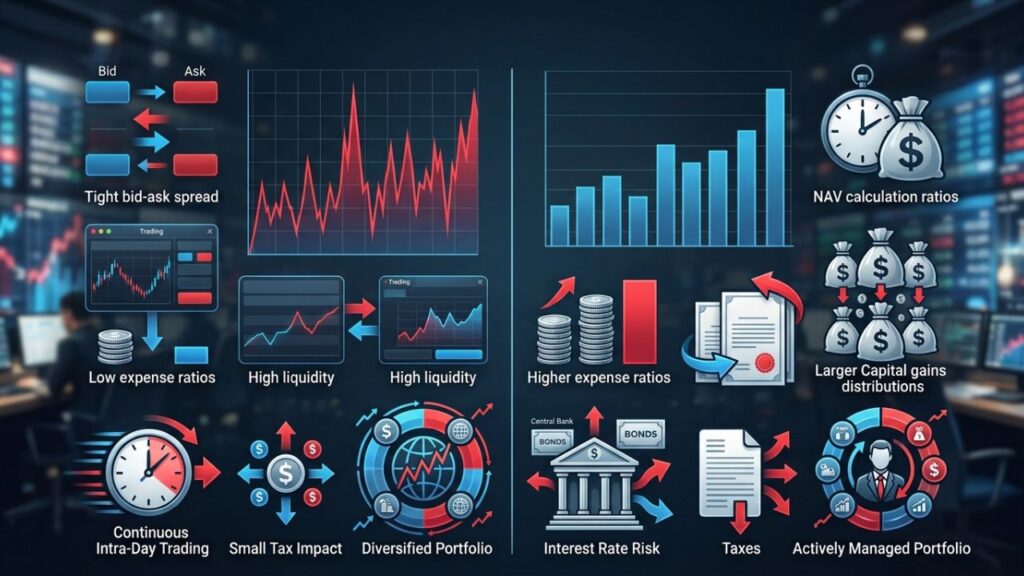
ETFs offer intraday trading flexibility, allowing investors to buy or sell at a specific price point during the day rather than waiting for a single daily valuation. Their typically lower expense ratios can reduce the drag of fees on long-term returns, and their tax structure often results in fewer unexpected capital gains distributions.
Mutual funds offer the convenience of automatic investment plans, dollar-cost averaging through regular contributions, and the option to buy fractional dollar amounts rather than whole shares in some cases. Actively managed mutual funds also give investors access to a manager’s ongoing security selection, which some investors prefer over a fixed index-tracking approach.
Neither structure guarantees better investment performance; the benefits described relate to cost, structure, and convenience rather than returns. Investors evaluating funds should also understand the underlying investments they hold, making How to Evaluate a Stock a helpful companion guide.
Risks, Drawbacks, or Limitations
ETF-specific considerations:
- Brokerage commissions or bid-ask spreads can add costs to frequent trading, even if the expense ratio itself is low.
- Intraday price fluctuations can tempt some investors toward more frequent trading, which may not align with long-term goals.
- Less liquid or niche ETFs can experience wider bid-ask spreads, which may affect the price received when buying or selling.
Mutual fund-specific considerations:
- Higher expense ratios, particularly for actively managed funds, can reduce net returns over time.
- Minimum investment requirements can be a barrier for investors with limited starting capital.
- Capital gains distributions can create a tax liability even for investors who have not sold any shares, including in years when the fund’s overall value declined.
- Orders are not executed at a known price; investors do not know the exact NAV until after the market closes.
Shared risks: Both ETFs and mutual funds carry the underlying investment risk of the assets they hold. A stock-based fund of either type can lose value if the stock market declines, and neither structure protects against market risk, sector concentration risk, or interest rate risk in bond holdings.

Who It May Be Suitable For
Investors who want intraday trading control, lower costs, and greater tax efficiency may find ETFs align with their preferences, particularly those using a brokerage account and comfortable managing their own trade timing.
Investors who prefer automatic recurring contributions, want access to active management, or are contributing to certain employer retirement plans that only offer mutual funds may find that structure more practical for their situation.
Who Should Be Cautious or Avoid It
Investors who trade ETFs frequently based on short-term price movements may incur transaction costs and risks associated with market timing, which can undermine long-term investment goals. Those unfamiliar with bid-ask spreads or limit orders may also want to research these mechanics before trading ETFs actively.
Investors who are highly cost-sensitive or who want to avoid unexpected tax bills may want to carefully review a mutual fund’s fee structure and historical capital gains distributions before investing, particularly with actively managed funds held in taxable accounts.
Alternatives or Related Options
Index funds (which can be structured as either ETFs or mutual funds) offer another way to gain diversified market exposure at a relatively low cost. Investors seeking exposure to international stock markets may also benefit from learning What Is a Global Equity Fund? which explains how globally diversified equity funds work. Target-date funds, typically structured as mutual funds, automatically adjust asset allocation as an investor approaches a specified date, such as retirement. Individual stocks and bonds offer direct ownership without pooling, though they require more research and do not provide built-in diversification.
Frequently Asked Questions
Can an ETF and a mutual fund track the same index?
Yes. Many fund companies offer both an ETF and a mutual fund version that track the same index, though fees and minimums may differ.
Are ETFs riskier than mutual funds?
Not inherently. Risk depends primarily on the underlying assets held, not the fund structure itself.
Do ETFs pay dividends?
Yes, if the underlying holdings pay dividends, the ETF typically passes these payments to shareholders, similar to a mutual fund.
Is it possible to lose money in either an ETF or a mutual fund?
Yes. Both are subject to market risk, and the value of shares can decline based on the performance of the underlying holdings.
Which has lower fees, an ETF or a mutual fund?
It varies by fund, but ETFs — especially passively managed index ETFs — often have lower expense ratios than actively managed mutual funds tracking similar assets.

Conclusion
ETFs and mutual funds both provide diversified exposure to a basket of securities but differ in trading mechanics, pricing frequency, cost structures, and tax treatment. ETFs trade throughout the day at market prices and often carry lower fees and greater tax efficiency, while mutual funds transact once daily at NAV and may offer certain conveniences like automatic contribution plans. Neither structure is inherently superior; the appropriate choice depends on an investor’s account type, cost sensitivity, trading preferences, and tax situation. As with any investment decision, reviewing a fund’s prospectus, fee schedule, and historical distributions can help clarify how a specific ETF or mutual fund may fit into an individual’s broader financial plan.