Investing often involves making decisions about when to buy assets, and many people worry about investing at the “wrong” time. Market prices can rise and fall unexpectedly, making it difficult to know when to invest a large amount of money. Dollar-cost averaging (DCA) is an investment approach designed to reduce the impact of this uncertainty by spreading investments over time rather than investing everything at once.
Instead of attempting to predict short-term market movements, DCA focuses on consistency. Investors contribute a fixed amount of money at regular intervals, regardless of whether prices are high or low. While this method does not eliminate investment risk or guarantee positive returns, it can help create a disciplined investing habit and reduce the emotional pressure associated with market fluctuations.
What Is Dollar-Cost Averaging
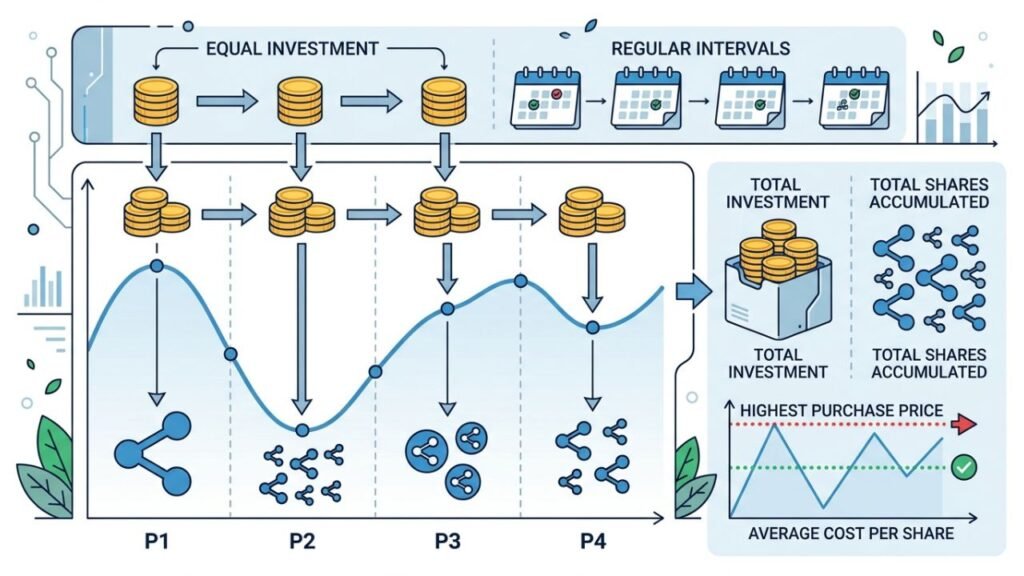
Dollar-cost averaging (DCA) is an investment strategy in which a person invests a fixed amount of money into the same investment at regular intervals, such as weekly, monthly, or quarterly. For readers who want additional educational information, the U.S. Securities and Exchange explains the strategy, how it works, and important considerations for investors.
Because the investment amount stays the same, the number of shares or units purchased changes depending on the market price. When prices are lower, the fixed investment buys more shares. When prices are higher, it buys fewer shares.
Over time, this results in an average purchase cost that may differ from the average market price. The primary goal of DCA is not to maximize returns but to reduce the impact of short-term price volatility and encourage consistent investing.
Dollar-cost averaging is commonly used with stocks, exchange-traded funds (ETFs), mutual funds, and retirement investment accounts.

How It Works
The process of dollar-cost averaging is relatively straightforward.
- Choose an investment, such as a diversified stock fund, ETF, or mutual fund.
- Decide on a fixed investment amount, for example, $200 each month.
- Select a regular investment schedule, such as every two weeks or once a month.
- Continue investing according to the schedule regardless of market conditions.
- Review the investment periodically to ensure it still aligns with long-term financial goals rather than making changes based on short-term market movements.
For example, suppose an investor contributes $300 every month to the same investment. If the share price is $30, the investor purchases 10 shares. The price later falls to $20, the same $300 buys 15 shares. If the price rises to $40, the investment purchases 7.5 shares. Over time, the average purchase price reflects multiple market conditions rather than a single entry point.
Key Features or Core Components
Dollar-cost averaging includes several defining characteristics.
Fixed Investment Amount
The investor contributes the same amount of money each investment period regardless of market performance. This consistency is central to the strategy.
Regular Investment Schedule
Investments occur at predetermined intervals, such as weekly, biweekly, or monthly. Maintaining the schedule is generally more important than reacting to short-term price changes.
Long-Term Perspective
DCA is typically intended for long-term investing rather than short-term trading. It is commonly used over many years to build an investment portfolio gradually. While dollar-cost averaging focuses on when investments are made, investors should also consider how their money is distributed across different types of investments. Understanding What Is Asset Allocation? can help explain how diversification and investment allocation work alongside a consistent contribution strategy.
Automatic Investing
Many investors automate recurring contributions from their bank account or paycheck. Automation can help reduce missed investments and support consistent saving habits.
Reduced Focus on Market Timing
Rather than trying to identify the best day or month to invest, DCA follows a predetermined plan that continues through different market conditions.
Benefits or Advantages
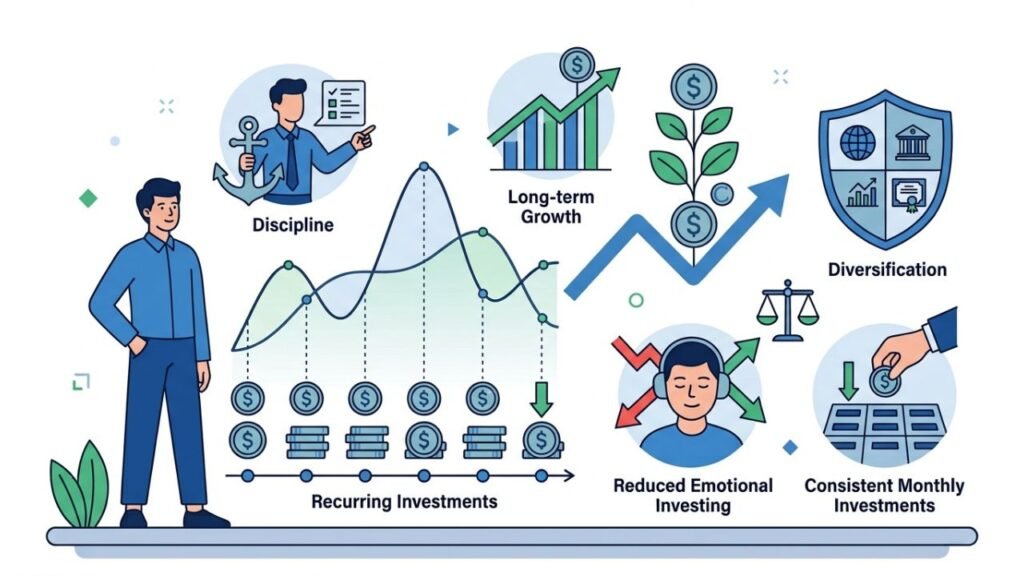
Dollar-cost averaging offers several potential benefits, although these benefits should be considered alongside its limitations.
Helps Reduce Timing Risk
Investing a large sum immediately before a market decline can lead to short-term losses. By spreading investments over time, DCA reduces the risk of investing all available funds at a single market peak.
Encourages Investment Discipline
A regular investment schedule helps establish consistent financial habits. This may reduce the temptation to delay investing while waiting for market conditions to appear more favorable.
Reduces Emotional Decision-Making
Market volatility often leads investors to make decisions based on fear or excitement. A structured investment schedule can make it easier to remain focused on long-term objectives rather than short-term price changes.
Accessible for Regular Income Earners
People who receive regular paychecks may find DCA practical because investments can be matched with recurring income instead of requiring a large lump-sum investment.
Simple to Understand
The strategy does not require advanced market analysis or frequent trading decisions. Many beginners appreciate its straightforward approach.
Risks, Drawbacks, or Limitations
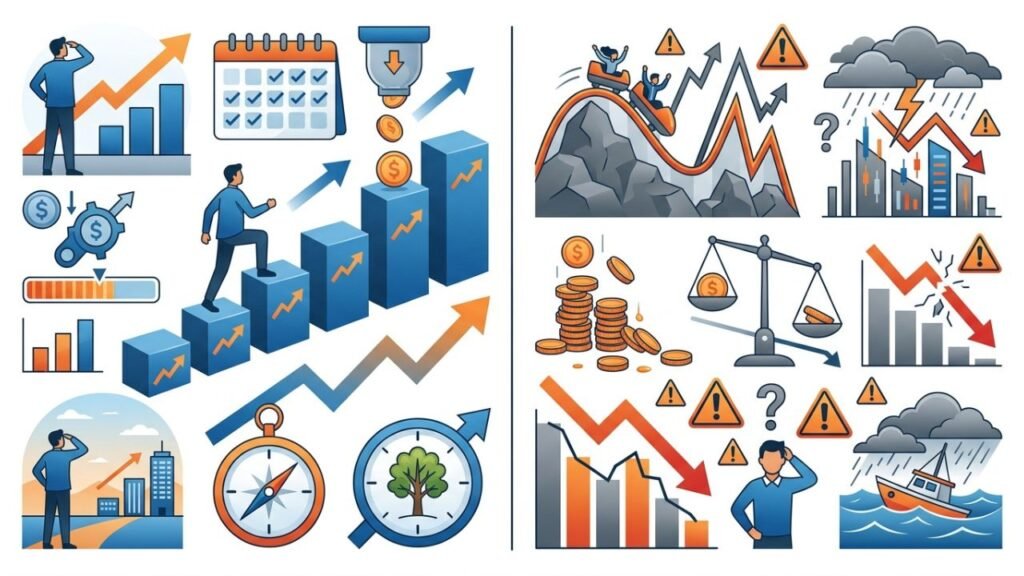
Although dollar-cost averaging has advantages, it also has important limitations that investors should understand.
Does Not Guarantee Profits
DCA cannot prevent investment losses. If the value of an investment declines over an extended period, the investor may still experience negative returns.
May Produce Lower Returns Than Lump-Sum Investing
If markets generally rise over time, investing a lump sum earlier may outperform spreading investments over several months because more money remains invested for longer. Historical studies have shown this outcome in many long-term rising markets, although individual circumstances vary.
Requires Consistency
The strategy depends on maintaining regular investments. Frequently stopping, skipping contributions, or changing the schedule may reduce its intended benefits.
Investment Quality Still Matters
Dollar-cost averaging does not improve a poor investment. If the chosen investment consistently underperforms or carries excessive risk, investing regularly will not solve those underlying issues.
Transaction Costs
If an investment platform charges commissions or fees for each purchase, frequent investing could increase overall costs. Many modern investment platforms offer low-cost or commission-free investing, but fees should always be reviewed.
Opportunity Cost
When an investor already has a large amount of cash available, gradually investing it through DCA may leave part of the money uninvested for an extended period, potentially reducing returns if markets rise during that time.
Who It May Be Suitable For
Dollar-cost averaging may be appropriate for:
- Individuals invest part of each paycheck on a regular schedule.
- Beginning investors seeking a structured investment approach.
- Long-term investors focused on retirement or other future financial goals.
- People who prefer reducing the stress of deciding when to invest.
- Investors who want to build consistent saving and investing habits over time.
Its suitability depends on personal financial circumstances, investment objectives, risk tolerance, and time horizon. Investors who are considering diversified funds as part of a long-term investment plan may also benefit from learning What Is a Global Equity Fund? which explains how globally diversified equity funds work and how they fit into broader investment portfolios.
Who Should Be Cautious or Avoid It
Dollar-cost averaging may not be appropriate in every situation.
People who have immediate cash needs or very short investment timeframes may require lower-risk options rather than market investments.
Investors considering highly speculative or volatile assets should understand that DCA does not remove the risks associated with those investments.
Individuals with high-interest debt or insufficient emergency savings may benefit from addressing those financial priorities before making regular investments in market-based assets.
Investors who already possess a carefully considered lump sum and have determined that immediate investment better fits their financial plan may choose a different approach.
Alternatives or Related Options
Several investment approaches are related to or differ from dollar-cost averaging.
Lump-Sum Investing
This approach involves investing all available funds at one time. It provides immediate market exposure but may increase short-term timing risk.
Value Averaging
Instead of investing a fixed dollar amount, value averaging adjusts investment amounts so the portfolio reaches a predetermined target value over time. This strategy is more complex than DCA.
Periodic Portfolio Rebalancing
Rebalancing involves adjusting investment allocations periodically to maintain a desired asset mix. While different from DCA, both strategies promote disciplined investing.
Buy-and-Hold Investing
Buy-and-hold focuses on purchasing investments and holding them for an extended period. Dollar-cost averaging is often used as the purchasing method within a broader buy-and-hold strategy.
Frequently Asked Questions
1. Is dollar-cost averaging only for beginners?
No. While beginners often use DCA because of its simplicity, experienced investors also use it to maintain disciplined investment habits or invest regular income over time.
2. Does dollar-cost averaging eliminate investment risk?
No. Investments can still lose value, and DCA does not guarantee positive returns. It mainly addresses the risk of investing all available money at one point in time.
3. How often should investments be made?
There is no single correct schedule. Weekly, biweekly, and monthly investments are all common. The most important factor is maintaining a consistent schedule that fits the investor’s financial situation.
4. Can dollar-cost averaging be automated?
Yes. Many financial institutions and investment platforms allow recurring automatic investments, helping investors maintain consistency without manually placing each investment.
5. Is dollar-cost averaging better than investing a lump sum?
Neither approach is universally better. Lump-sum investing may produce higher returns in markets that generally rise over time, while DCA may reduce the emotional and timing risks associated with investing a large amount at once. The appropriate choice depends on an individual’s financial circumstances, goals, and comfort with market fluctuations.
Conclusion
Dollar-cost averaging is a straightforward investment strategy that emphasizes consistency rather than attempting to predict short-term market movements. By investing a fixed amount at regular intervals, investors purchase more shares when prices are lower and fewer when prices are higher, helping spread purchases across different market conditions.
Although this approach can encourage disciplined investing and reduce timing risk, it does not eliminate market risk or guarantee investment success. Like any investment strategy, dollar-cost averaging should be considered alongside personal financial goals, risk tolerance, investment timeframe, and the characteristics of the investments being purchased.