Blockchain technology has become an important part of discussions about digital finance, cybersecurity, and data management. Although it is often associated with cryptocurrencies, its potential applications extend well beyond digital assets. Organizations across industries are exploring blockchain as a way to improve record-keeping, increase transparency, and reduce reliance on centralized systems.
Blockchain stores information in a shared digital ledger that a network of computers maintains instead of a single authority. This structure makes verified records difficult to alter and helps participants build trust without relying on one central organization. Understanding how blockchain works helps people evaluate its practical uses, benefits, and limitations across financial and non-financial applications.
What Is Blockchain Technology?
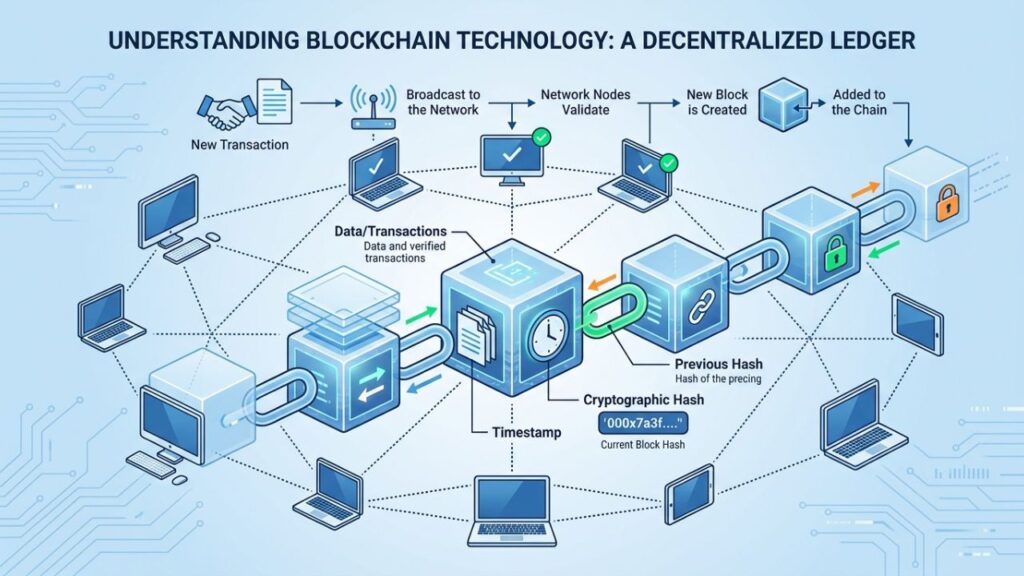
Blockchain is a decentralized, distributed digital ledger that records transactions or other types of data across a network of computers, known as nodes. For a deeper technical explanation of blockchain concepts, IBM provides an overview of blockchain networks, distributed ledgers, and enterprise applications in its educational resources on IBM Blockchain. Instead of storing records in a single database controlled by one organization, identical copies of the ledger are maintained by multiple participants within the network.
Information is stored in groups called blocks. Each block contains data, a timestamp, and a unique cryptographic identifier known as a hash. Every new block references the hash of the previous block, creating a continuous chain of records. This design helps preserve the integrity of the ledger because changing one block would require altering all subsequent blocks across the network.
The technology is intended to provide transparency, security, and data integrity while reducing the need for centralized intermediaries in certain applications. Although blockchain is widely known because of cryptocurrencies, the two are not the same. Readers who want to understand how digital currencies use blockchain can also read What Is Cryptocurrency?
How Blockchain Technology Works
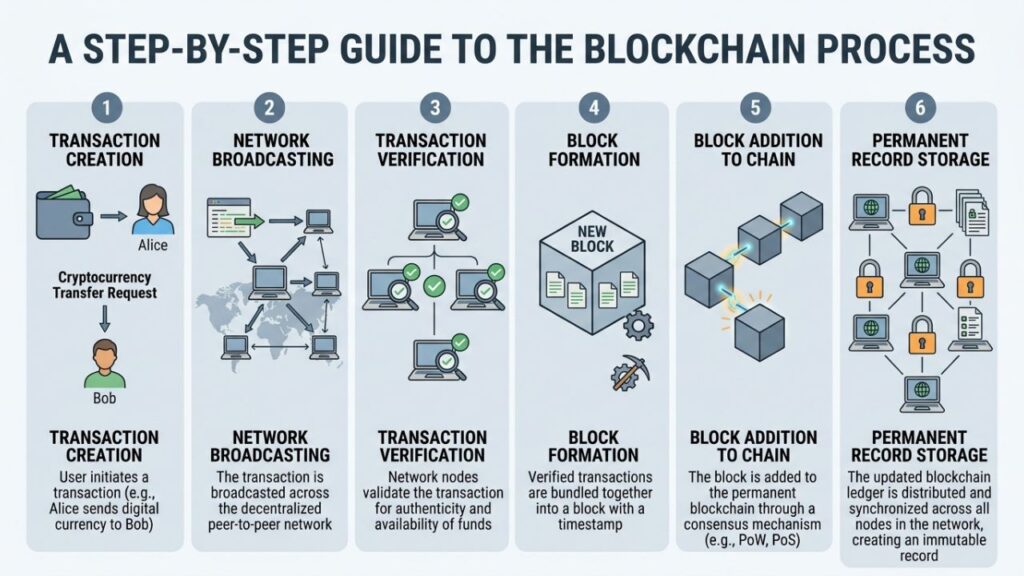
Blockchain follows a structured process to record and verify information.
1. A Transaction Is Created
A transaction or data entry is initiated. Depending on the blockchain’s purpose, this may involve sending digital assets, recording ownership information, storing documents, or logging business events.
2. The Transaction Is Broadcast
The transaction is shared with the blockchain network. Computers participating in the network receive the proposed transaction and prepare to verify its validity.
3. Network Participants Validate the Transaction
The network uses a consensus mechanism to determine whether the transaction follows the established rules.
Two widely used consensus methods include:
- Proof of Work (PoW): Participants, often called miners, solve complex mathematical problems to validate transactions and add new blocks.
- Proof of Stake (PoS): Proof of Stake selects validators based on factors such as the amount of cryptocurrency they commit, which reduces the computational requirements compared with Proof of Work.
Different blockchain platforms may use alternative consensus models depending on their design goals.
4. Transactions Are Grouped into a Block
Once verified, multiple transactions are collected into a new block. The block includes transaction data, a timestamp, and the cryptographic hash of the previous block.
5. The Block Is Added to the Chain
After network approval, the new block becomes part of the existing blockchain. Every participant updates their copy of the ledger to reflect the latest version.
6. The Record Becomes Highly Resistant to Modification
Because every block links to previous blocks through cryptographic hashes, changing historical records would require extensive agreement, significant computational effort, and verification from participants across the entire network. This structure contributes to blockchain’s reputation for immutability, although the exact level of resistance depends on the specific blockchain’s design and governance.
Key Features and Core Components
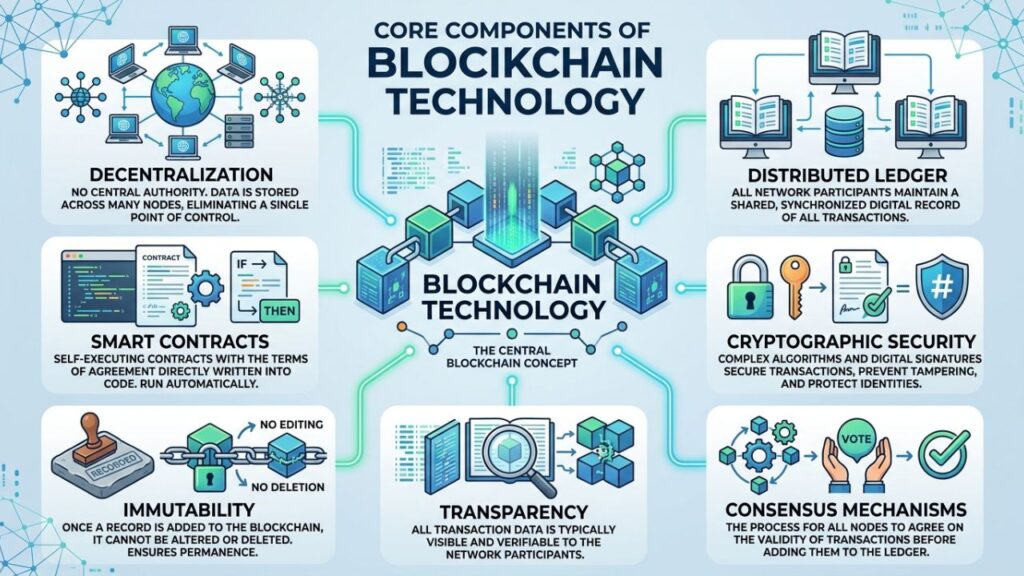
Decentralization
Instead of relying on a central authority, blockchain distributes responsibility across many network participants. This can reduce single points of failure and increase resilience.
Distributed Ledger
Each participating node typically maintains a copy of the blockchain. Multiple copies improve redundancy and help ensure consistency across the network.
Cryptographic Security
Blockchain relies on cryptographic hashing and digital signatures to help secure transactions and verify ownership or authorization.
Consensus Mechanisms
Consensus algorithms allow network participants to agree on the validity of transactions without requiring complete trust in one another.
Transparency
Many public blockchains allow anyone to view transaction histories. Although wallet addresses are visible, personal identities are not automatically revealed.
Immutability
Once transactions are confirmed and added to the blockchain, modifying historical records becomes extremely difficult without broad network agreement.
Smart Contracts
Some blockchain platforms support smart contracts, which are self-executing programs that automatically perform predefined actions when specified conditions are met.
Benefits and Advantages
Improved Data Integrity
Blockchain’s linked structure helps protect records from unauthorized modification. This can improve confidence in the accuracy of stored information.
Greater Transparency
Public blockchain networks allow participants to independently verify transactions. This transparency can support auditing and accountability.
Reduced Dependence on Intermediaries
In some applications, blockchain enables transactions to occur directly between participants, reducing reliance on centralized organizations for verification.
Enhanced Traceability
Industries such as supply chain management can use blockchain to track products from origin to destination, improving visibility throughout the process.
Increased Security
Distributed storage and cryptographic verification make unauthorized changes more difficult than in many traditional centralized systems.
Automation Through Smart Contracts
Smart contracts automate repetitive processes, potentially reducing manual administration and minimizing execution errors when users clearly define the conditions.
Risks, Drawbacks, and Limitations
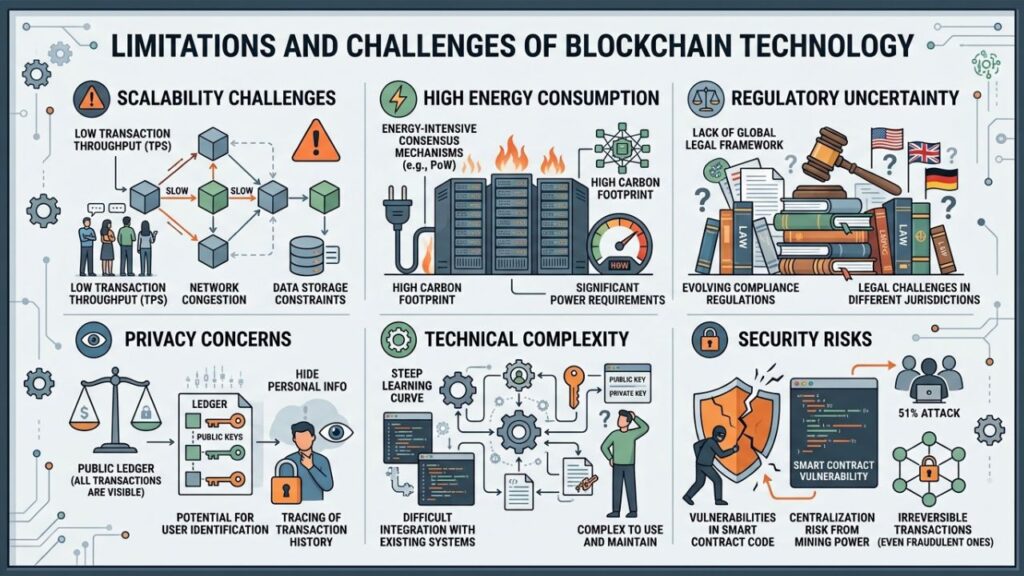
Scalability Challenges
Some blockchain networks process transactions more slowly than conventional payment systems or centralized databases. Higher network usage may increase delays and transaction costs.
Energy Consumption
Certain consensus mechanisms, particularly Proof of Work, require substantial computing power and electricity. Although newer systems often use more energy-efficient approaches, environmental considerations remain relevant for some networks.
Regulatory Uncertainty
Laws governing blockchain applications vary across jurisdictions and continue to evolve. Organizations using blockchain may need to adapt to changing legal and compliance requirements.
Data Privacy Concerns
While blockchain offers transparency, permanently storing certain information may conflict with privacy regulations if sensitive data is recorded directly on the chain.
Irreversible Transactions
Many blockchain transactions cannot easily be reversed once confirmed. Errors such as sending assets to an incorrect address may be difficult or impossible to recover.
Technical Complexity
Blockchain concepts, digital wallets, private keys, and consensus mechanisms can be difficult for beginners to understand. Improper management of cryptographic keys may result in permanent loss of access to digital assets. Improper management of cryptographic keys can lead to losing access to digital assets. Understanding how wallets store and protect these keys is important, especially when comparing different wallet types. Learn more in What Is a Crypto Wallet? Hot Wallet vs. Cold Wallet.
Governance Differences
Not all blockchains operate in the same way. Public, private, and consortium blockchains have different governance structures, security models, and operational rules that may affect their suitability for specific applications.
Who It May Be Suitable For
Blockchain technology may be appropriate for:
- Organizations seeking transparent and tamper-resistant record-keeping.
- Businesses managing complex supply chains requiring product traceability.
- Developers building decentralized applications using smart contracts.
- Financial institutions researching distributed settlement systems.
- Individuals interested in understanding emerging financial and digital technologies.
Its suitability depends on the specific use case, technical requirements, regulatory environment, and operational objectives.
Who Should Be Cautious or Avoid It
Blockchain may not be the best solution for every situation.
Organizations that require high transaction speeds with minimal costs may find traditional databases more practical. Businesses handling highly confidential information should carefully evaluate privacy requirements before storing data on blockchain systems.
Individuals unfamiliar with digital security practices should exercise caution when managing blockchain-based assets, particularly where private keys or wallet credentials are involved. Additionally, organizations operating in highly regulated industries should assess applicable legal obligations before implementing blockchain solutions.
Alternatives or Related Options
Several technologies may address similar needs depending on the application.
Traditional centralized databases offer high performance, lower operational complexity, and established management tools. They remain suitable for many business applications where centralized control is appropriate.
Distributed databases provide data replication across multiple locations without necessarily using blockchain’s consensus mechanisms.
Cloud-based record management systems allow organizations to securely store and share information while benefiting from centralized administration and scalability.
Permissioned blockchain networks restrict participation to approved members, making them suitable for enterprise environments where greater control and privacy are required.
Frequently Asked Questions
Is blockchain the same as cryptocurrency?
No. Blockchain is the underlying technology that can support cryptocurrencies, but it also has applications in supply chain management, digital identity, healthcare, document verification, and many other fields.
Can blockchain records be changed?
Blockchain records are designed to be highly resistant to modification after confirmation. Altering historical data generally requires broad network agreement and significant computational effort, depending on the blockchain’s architecture.
What is a smart contract?
A smart contract is a computer program stored on a blockchain that automatically executes predefined actions when specified conditions are satisfied. It can reduce the need for manual processing in certain workflows.
Are all blockchains public?
No. Some blockchains are public and open to anyone, while others are private or permissioned, allowing only authorized participants to access or validate information.
Does blockchain eliminate all security risks?
No. Although blockchain offers strong security features, risks remain. Software vulnerabilities, compromised private keys, human error, fraud, and poor system design can still lead to losses or operational problems.
Conclusion
Blockchain technology is a decentralized system for recording and verifying information across a distributed network of computers. By combining cryptographic security, consensus mechanisms, and linked data structures, it provides a method for maintaining records that are transparent and resistant to unauthorized modification.
While blockchain offers meaningful advantages in areas such as data integrity, traceability, and decentralized verification, it also presents challenges including scalability limitations, regulatory uncertainty, technical complexity, and privacy considerations. As a result, blockchain is not a universal replacement for traditional databases but rather a specialized technology suited to particular use cases. Understanding both its strengths and its limitations enables individuals and organizations to evaluate where blockchain may provide practical value and where alternative solutions may be more appropriate.